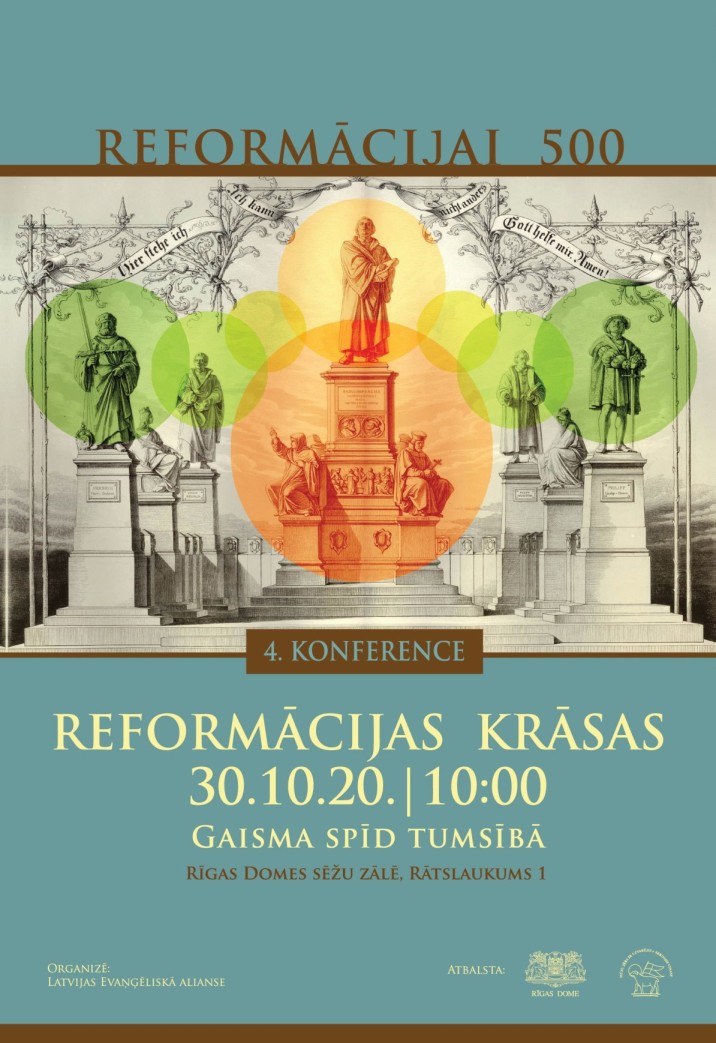
REFORMATION COLOURS on 30 October at 10:00
30 October, 10:00, in the Riga City Council meeting hall
For the fourth year already the Latvian Evangelical Alliance is organising a conference cycle dedicated to the 500th anniversary of the Reformation. It is planned until 2022, when we will mark the 500th anniversary of Riga as a city of the Reformation. As far as is currently known, Riga was the first city to accept the Reformation.
The themes will cover not only the 16th century of the Reformation itself, but also the time before and after the Reformation - from the 13th to the 18th century - revealing the Reformation as a many-sided and many-coloured process of renewal of Christ’s church and society. A time in which Divine Light shines into human darkness.
W. Churchill said, “Those who do not learn from history are doomed to repeat it.” History teaches us to live the future. History shows us how God’s Word and law work in life - it is like a compass that points the way forward in God’s paths so that we do not go back into human mistakes.
Conference programme:
9:30 Arrival;
10:00 Conference opening;
10:30 Ugis Sildegs, Dr.theol. “On the Freedom of a Christian” (1520);
11:00 Janis Silins, Dr.hist. “The attitude of the Brethren congregations toward gender and sexuality”;
11:30 Gints Lusis Grinbergs. “The Misunderstood Reformation. 16th-century Anabaptists - heretics, witches or saints?”;
12:00 (Lunch break)
13:00 Roberts Spirgis, Dr.hist. “The Chronicle of Henry of Livonia on the coexistence of the Latin and Orthodox churches in eastern Latvia at the beginning of the 13th century: historiography and prospects for further research.”;
13:30 Aija Taimina, Dr.philol. “‘Unless the Lord guards the city...’: documents from the tower balls of Riga churches (15th-18th centuries)”;
14:00 (Break);
14:20 Beata Paskevica, Dr.philol. “Theology of the heart in the autobiography of Friedrich Bernhard Blaufuss”;
14:50 Gundars Ceipe, Dr.hist. “The Latvian Brethren congregation in the context of the global tradition”;
15:20 Panel discussion;
15:50-16:00 Conference closing.
Lecture annotations:
Ugis Sildegs, Dr.theol. “On the Freedom of a Christian” (1520)
When Luther discovered the Gospel, he experienced such freedom as if he had lost all chains. In 1517 he even wished, in the humanist fashion, to change his name to Eleutherios (Greek) - “the liberated one”. With the first thesis of this work he expresses this powerful taste of freedom: a Christian is free, lord over all things and subject to no one! But at the same time, in the new consciousness of freedom, Luther is also able to confess the opposite: a Christian is a submissive servant in all things and subject to everyone. This work, written exactly 500 years ago, is one of the keys to a true understanding of the Reformation.
Janis Silins, Dr.hist. “The attitude of the Brethren congregations toward gender and sexuality”.
“One of the essential aspects of the Reformation was a change in attitudes toward human sexuality and the role of marriage in it. Most Protestants rejected celibacy and called clergy to form families. The Brethren congregations, or Herrnhuter movement, in the 18th century brought significant, sometimes even radical, changes in this matter. Within the movement there was a strict separation of genders, but at the same time an even greater emphasis on the importance of marriage, including sexual relations within marriage.”
Gints Lusis Grinbergs “The Misunderstood Reformation. 16th-century Anabaptists - heretics, witches or saints?”
Popular history does not mention the Anabaptists as part of the Reformation. Yet the Anabaptists are predecessors of a very large part of today’s evangelical Christians. In the 16th and 17th centuries they were regarded as heretics, as sorcerers and witches, and as saints. Who, then, were the Anabaptists, and what was their faith and conduct?
Roberts Spirgis, Dr.hist. “The Chronicle of Henry of Livonia on the coexistence of the Latin and Orthodox churches in eastern Latvia at the beginning of the 13th century: historiography and prospects for further research.”
What took place in the eastern part of Latvia’s territory in the 13th century in connection with the incorporation of the eastern church into western state and spiritual systems? Why were Orthodox rulers in the Baltics ready to cooperate with Riga? Burial traditions from the 12th to the 14th century, as well as later Orthodox objects of personal piety, are silent witnesses to the complicated process of integrating the margins of the eastern church during the formation of Latin Livonia.
Aija Taimina, Dr.philol. “‘Unless the Lord guards the city...’: documents from the tower balls of Riga churches (15th-18th centuries)”
Aija Taimina, head and leading researcher of the Manuscripts and Rare Books Department of the Academic Library of the University of Latvia, gives an engaging overview of the documents left in the tower balls of Riga churches - testimonies and messages to future generations.
Beata Paskevica, Dr.philol. “Theology of the heart in the autobiography of Friedrich Bernhard Blaufuss”
Friedrich Bernhard Blaufuss, Lutheran pastor of St James’ Church, author of the first historical overview of Vidzeme in Latvian and supporter of the Herrnhuter movement, left his autobiography to future generations. The story, formed in the tradition of St Augustine and also Halle Pietism, is mainly the story of an individual soul’s, or more precisely, using the author’s own terminology, heart’s spiritual search and growth, a description of the process by which theological concepts learned in the mind are transformed for receiving the evangelical message in his own heart and in the hearts of the pastor’s hearers.
Gundars Ceipe, Dr.hist. “The Latvian Brethren congregation in the context of the global tradition”
The revival of the Brethren congregation in Latvia’s territory in the 18th and 19th centuries is one of the greatest spiritual revivals in world history. How does it fit into the overall tradition and history of the movement, and what are the unique aspects and contribution of the Latvian Brethren congregation?