Being a Family Is an Art
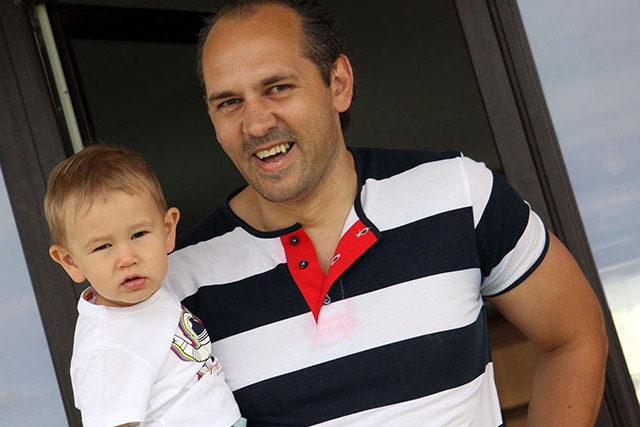
The Ozolinkevics family.
“There are very many good mothers, but few good fathers. And precisely because we have a good one, we can be such a large and strong family,” says Baiba Ozolinkevica, mother of seven children.
Although Baiba and Modris did not come from large families, seven children are growing up in the Ozolinkevics family in Marupe - five sons and two daughters. The parents admit that they had never thought about having such a large family. “Before the wedding we talked about how many children there might be in our family. Baiba said she wanted at least three, and I agreed with her - I also thought three would be good. Well, if each has three, then together that already makes six. Plus one more as a bonus. I will say honestly - I never thought I would be the father of seven children,” Modris laughs.
Baiba does not hide that because of the children she has had to give up many things. “When my boys were born, I understood - if I want a family, I must take that into account. I do not have much work experience or higher education.
I finished the same art secondary school where Kristians now studies, and now I laugh that all my art is in the children. In my life I am most of all a mother. And a mother is always a mother, no matter how many children she has.”
Their own gathering
The eldest son, Daniels, is 20 and studies at the European Theological Seminary in Germany. Nineteen-year-old Edijs graduated this year from Riga English Grammar School and is thinking about studies at the Turiba University. Kristians is 17 and in autumn will continue his studies in the 12th grade of Riga Design and Art Secondary School. Sixteen-year-old Marta's passion is basketball, and she studies at Riga English Grammar School. Six-year-old sister Patricija will start school in autumn at the “Harmonija” primary school, while Domenika, who is already eight, will go there in the second grade. The youngest child in the family, Sebastians, is only one year and four months old. Baiba admits that in her own childhood she suffered deeply from her parents' divorce and from being the only child in the family. “My mother was a doctor, worked very much, and I was often alone. About my own family I knew that I did not want only one child. Now I look at them and rejoice - I never had such a gathering.”
“Everyone does everything,” says Modris when asked about the division of duties in the family. “The children know that they must take care of their rooms. Everyone takes part in cleaning the house, sometimes cooks, and the older ones look after the younger ones. If there are special jobs, then everyone joins in.” Baiba adds that in the old house, when there was not yet a dishwasher, a schedule had been made for that task. And when repairs had to be done in the house, everyone also got involved and helped. “Everything we could do, we did ourselves. Afterwards my eldest son told me - now at least I know what a house is made of.”
Large family = disadvantaged family
In the 1990s, when the Ozolinkevics family had four sons, they felt a dismissive attitude from society. An equal sign was already placed between a family with four children and a disadvantaged family. Now the attitude has changed a little, the parents have observed. The sons admit that at school they have not had to face unpleasant or awkward situations because of the large family. “Sometimes they only joke that we live in a kindergarten or that I have a million brothers and sisters,” Daniels laughs. He admits that it is always fun in the family. You can always play basketball in teams with the brothers - two against two. Although in daily life there is no reason to complain about boredom, brother Edijs laughingly admits that he himself is not yet thinking about a family with seven children.
When Baiba and Modris told their sons that Domenika was expected to enter the family, they did not jump into the air for joy. The father remembers one vivid episode when Daniels protested against the news: “He said: ‘Just when Marts has grown up a little and all the quarrels are over, everything will start again.’ He went upstairs to the second floor, after a while came down and said: ‘I thought it over and changed my mind. It will be cool!’ At first it seemed that Kristians also did not like his sister very much, but once from a trip to Sweden he brought home a gift for only one person - he had spent all his money on a shirt for his sister.”
Each one with his or her own blessing
Modris emphasizes that each child enters the family with his or her own blessing, but “many people think that they only take away. That is why, they say, one cannot have many children - they take my time, my money, my, my, my. And considering that ‘I’ and ‘mine’ currently rule in the world, large families are becoming fewer and fewer. We live in an egoistic consumer society; that is a fact.” Baiba adds: “When one lady found out how many children I have, she asked - when do you live, then?” “I answered her that I live with the children. And the more children there are, the more family-like the family is.”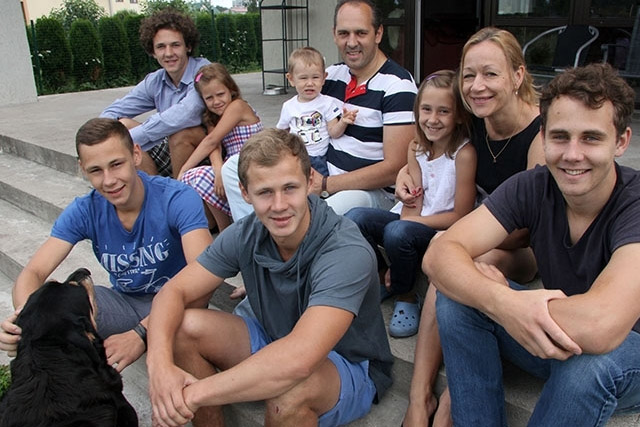
“Recently it happens more and more rarely that we are all together. Now everyone has their own affairs, places to go and things to do; we are no longer all together so often, but we try. We like it and it is important. At least once a week we try to find an evening or morning to be together,” says the father. The large Ozolinkevics family in Marupe: son Marts (16), Edijs (19), and Daniels (20). In the second row - Kristians (17), Patricija (6), Sebastians (1 year 4 months), father Modris, Domenika (8), and mother Baiba.
Faith in God has great importance in the Ozolinkevics family. Modris is convinced that to a large extent it is precisely this that holds the family together. He does not hide that in their life together there have been all kinds of times, but the idea that marriage is for life has always been the foundation. “One wife, and that is all. I quite often have to face a stupid question. When people find out that I have seven children, they ask: ‘From one wife?’ Many men have many children, but they are from two, three, four wives. If you have conviction and motivation that your wife truly is one and for your whole life, then the family also becomes strong. The children can also feel safer and more confident, instead of thinking - will there be a family or not, will dad be there or not?”
They buy what is needed, not what they want
Modris does not deny that a family with seven children also needs decent income, and that as a father this places certain responsibilities on him to provide for it. “When four boys went to school, for them to get to school and back and eat there, each needed at least three lats a day. That is 12 lats a day. If we count 20 working days in a month, that already comes to more than 240 lats.” The family does not often eat outside the home, because those are significant expenses. When buying food at the store, they pay attention to discounted goods. “We very rarely buy what we simply feel like having. Mostly we buy what is necessary and what is on discount.”
The house in Marupe was purchased only in 2011, when real estate prices had fallen sharply. Modris admits that he had wanted to buy his own home earlier, but the factor of a large family played a decisive role in the bank not granting a loan earlier. “If income is divided per head, then it comes out below the subsistence minimum, and the bank no longer gives a loan.”
Modris believes that today there are few good fathers because there is no one to take as an example. “Society emphasizes professional achievements, but never talks about family. It never talks about a person as a good father; only what you are like outside is highlighted. A good father is not valued in society. The primary things are how much you earn, what car you drive, what hobby you have - those are the emphasized values. Young guys see that, and they strive to live that way themselves. We seem to say that family is a value, but at the same time we set other priorities.”
Article republished from www.aprinkis.lv
Photo: Krisjanis Grantins